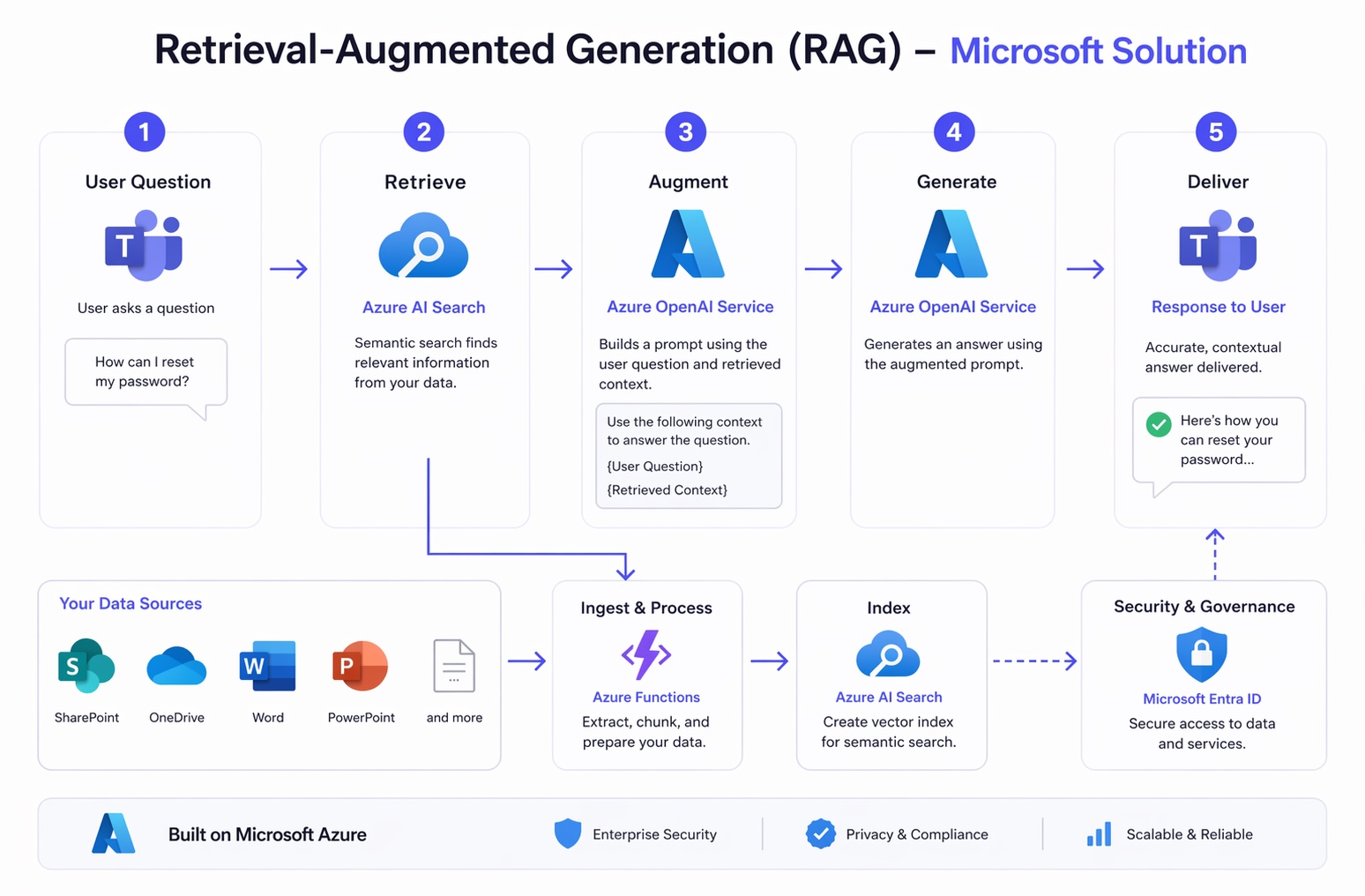
How RAG Is Revolutionising Enterprise Knowledge Management
Retrieval-Augmented Generation (RAG) represents a fundamental shift in how organisations interact with their knowledge bases. Rather than relying solely on a language model's training data, RAG systems retrieve relevant documents from your proprietary data stores and use them to generate accurate, contextual responses.
For Australian enterprises dealing with complex regulatory environments, internal policies, and vast document repositories, RAG offers a way to make institutional knowledge instantly accessible to every team member.
Why RAG Matters for Enterprise
Traditional search systems return documents — RAG returns answers. When an employee asks "What's our policy on remote work for contractors in NSW?", a RAG system doesn't just find the relevant policy document. It reads it, understands the context of the question, and provides a direct, accurate answer with citations.
Key Components of a Production RAG System
A robust RAG implementation requires several components working together:
Document Processing Pipeline — Ingesting, chunking, and embedding your documents into a vector database. The chunking strategy alone can make or break retrieval quality.
Vector Database — Storing and efficiently searching document embeddings. Options like Pinecone, Weaviate, or Azure AI Search each have trade-offs around scale, cost, and latency.
Retrieval Strategy — Hybrid search combining semantic similarity with keyword matching typically outperforms either approach alone.
Generation Layer — The LLM that synthesises retrieved context into coherent answers, with proper citation and confidence scoring.
Getting Started
The most successful RAG implementations start small — pick a well-defined knowledge domain, build a proof of concept, measure accuracy rigorously, then expand. We've seen Australian enterprises achieve 90%+ accuracy on domain-specific questions within weeks of deployment.