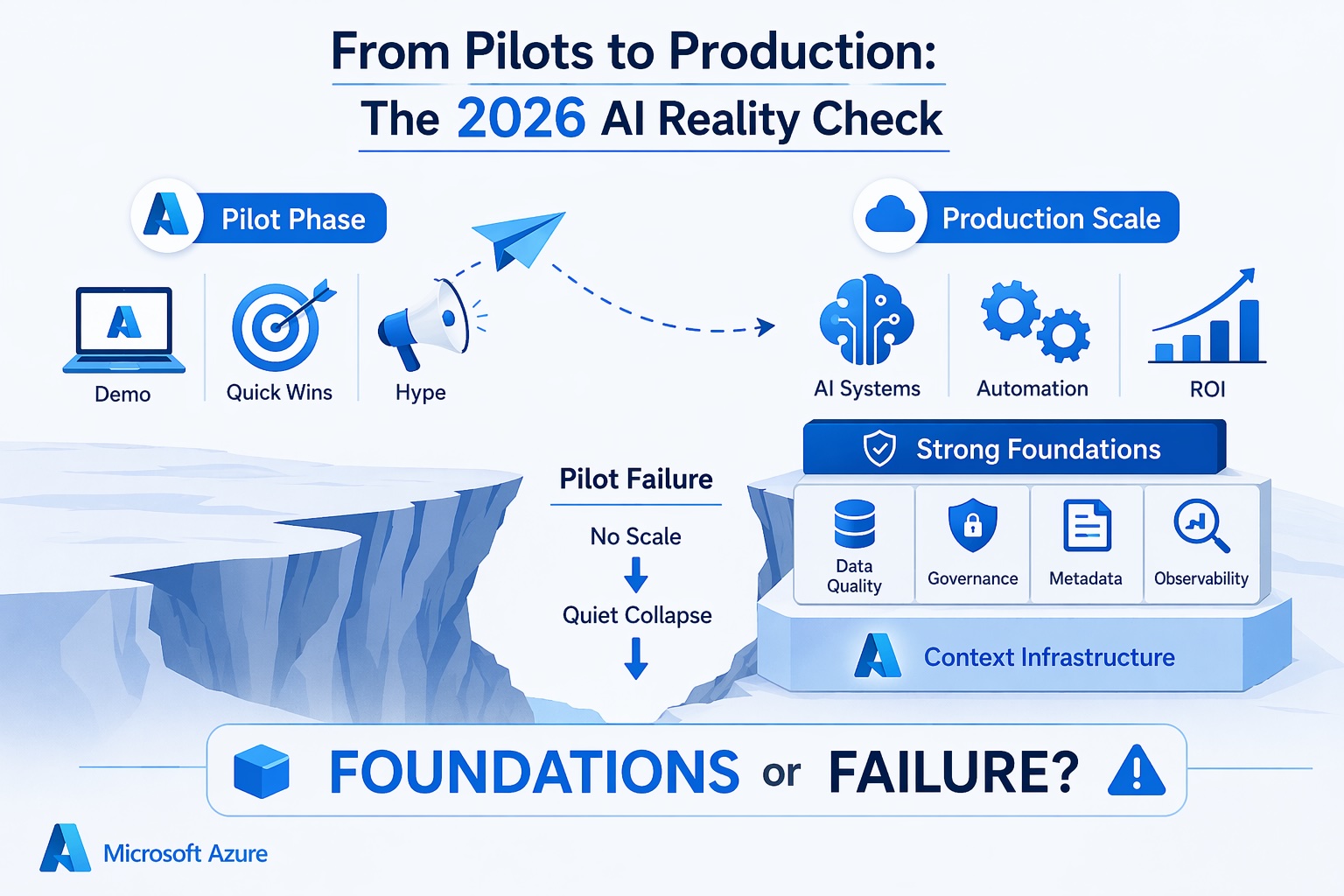
From Prototype to Production: Scaling AI Systems That Work
Every AI project starts with excitement — a prototype that shows promising results, stakeholders who are impressed, and momentum to "just deploy it." This is where most AI projects fail.
The gap between a working prototype and a production system is not a small step — it's a fundamentally different engineering challenge. Here's how to bridge it.
Why Prototypes Fail in Production
Scale — Your prototype worked on 100 requests per day. Production needs to handle 10,000 per hour with consistent latency. The architecture that works for one doesn't work for the other.
Reliability — A prototype can crash and you restart it. A production system needs 99.9% uptime, graceful error handling, and automatic recovery.
Data quality — Prototypes use clean, curated datasets. Production encounters messy, incomplete, adversarial inputs that break assumptions.
Cost — That GPT-4 call in your prototype costs $0.03. At production scale, you're looking at thousands per month. Optimisation matters.
Architecture Patterns That Scale
Async processing — Not everything needs real-time responses. Queue-based architectures let you handle load spikes gracefully and retry failures without blocking users.
Caching layers — Many AI queries are repeated or similar. Semantic caching can reduce model calls by 30-50% while maintaining quality.
Model cascading — Use a fast, cheap model for simple cases and escalate to expensive models only when needed. This dramatically reduces cost while maintaining quality where it matters.
Circuit breakers — When downstream services (model APIs, databases) are struggling, fail fast rather than queuing up requests that will timeout anyway.
Testing AI Systems
Traditional unit tests aren't sufficient for AI systems. You need:
- **Evaluation datasets** — Curated sets of inputs with expected outputs, covering normal cases, edge cases, and adversarial inputs.
- **Regression testing** — Ensure model updates don't degrade performance on previously-working cases.
- **Load testing** — Verify your system handles production traffic patterns without degradation.
- **Chaos testing** — What happens when the model API is slow? When the database is unavailable? When input data is malformed?
The Production Checklist
Before deploying any AI system to production, ensure you have:
- Monitoring and alerting for model performance metrics
- Automated rollback capability
- Rate limiting and cost controls
- Input validation and sanitisation
- Audit logging for all model decisions
- Documented runbooks for common failure modes
- Load tested to 2x expected peak traffic
Start Right
The best time to think about production is at the start of the project, not after the prototype impresses stakeholders. Build production concerns into your architecture from day one, even if the initial implementation is simple.